
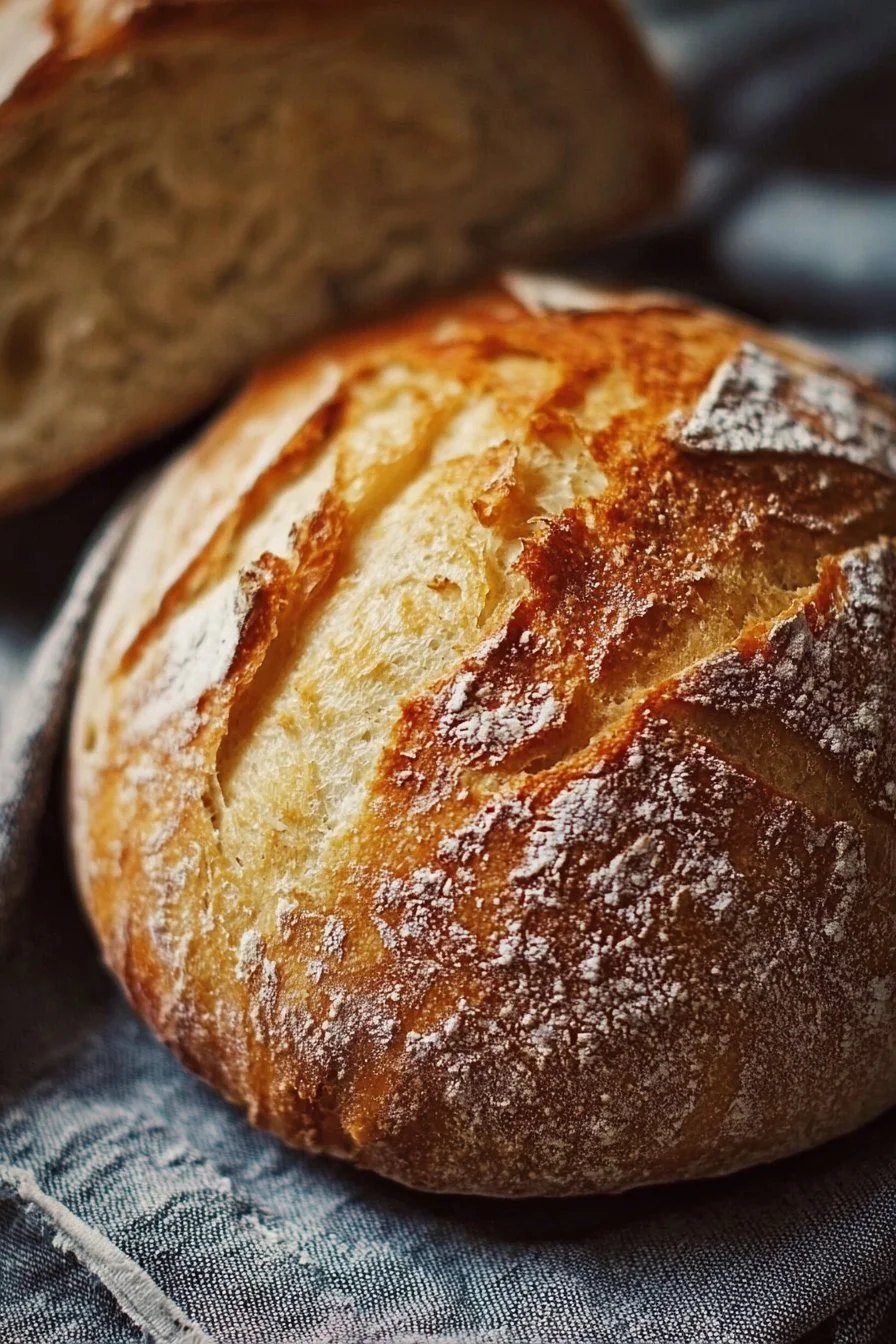
There’s something almost magical about a loaf that starts with four pantry basics and ends up with a crackly crust and a cloud-like crumb. This simple artisan bread recipe—made from flour, water, a pinch of instant yeast, and salt—uses a long, slow rest to develop flavor and structure without kneading. It’s perfect for weeknight dinners, weekend baking experiments, or anytime you want bakery-quality bread with very little fuss. If you want background on the technique and other no-knead tips, check this helpful guide to homemade artisan bread.
Why you’ll love this dish
This loaf is straightforward but impressive. You don’t need special equipment or advanced skills—just patience. The long rest (12–18 hours) develops deep, slightly tangy flavor and lets a small amount of yeast do the heavy lifting. The result: a chewy interior and a blistered, crisp crust that’s ideal for sandwiches, dipping, or tearing with soup.
“I made this with the exact pantry staples and was stunned by how much flavor came from just time and heat. Minimal hands-on time, maximum payoff.” — a home baker’s quick review
Reasons to make it:
- Minimal hands-on time—mix, rest, shape, bake.
- Budget-friendly: pantry staples only.
- Impressive crust and crumb without kneading.
- Great for leftovers: makes fantastic breadcrumbs or toast.
The cooking process explained
You’ll mix a shaggy dough, let it ferment slowly at room temperature, shape with a few folds, proof briefly, and bake it inside a preheated Dutch oven to trap steam. That enclosed baking creates the oven spring and crisp crust. Expect about 12–18 hours for the first rest, 1–2 hours for the final rise, and 45–50 minutes of baking.
Key ingredients
- 3 cups all-purpose flour — use spoon-and-level measuring for accuracy. Bread flour works too for slightly more chew.
- 1 1/2 cups water, room temperature — you want the dough wet and tacky.
- 1/4 teaspoon instant yeast — a tiny amount because the long rest develops flavor.
- 1 teaspoon salt — brings out flavor and strengthens the dough.
If you love herbs and savory add-ins, a garlic-and-rosemary version is a popular twist; you can see a flavored take on this style at garlic rosemary artisan bread.
Substitutions/notes:
- Whole-wheat: swap up to 1 cup for a nuttier loaf (add a touch more water).
- Active dry yeast: can be used, but dissolve it in a bit of the water first and wait until it foams (about 5–10 minutes).
- Salt: don’t skip—flavor will be flat without it.
Step-by-step instructions
- In a large bowl, whisk the flour, salt, and instant yeast until evenly combined.
- Slowly pour in the water while stirring with a wooden spoon or your hands. Mix until a shaggy, cohesive dough forms—it will be wet and sticky.
- Cover the bowl tightly with plastic wrap. Let rest at room temperature for 12 to 18 hours. The dough should rise and be dotted with air bubbles.
- Flour your work surface lightly, turn the dough out, and fold it over itself a few times to form a loose ball. Handle gently to preserve air pockets.
- Place the dough on a lightly floured towel or parchment, cover with a clean towel, and let rise 1 to 2 hours until slightly puffy.
- Preheat the oven to 450°F (230°C) with a Dutch oven inside for at least 30 minutes. The pot must be very hot.
- Carefully transfer the dough into the hot Dutch oven (use parchment if you like). Cover with the lid and bake 30 minutes.
- Remove the lid and bake another 15–20 minutes until deep golden brown and the crust is crisp.
- Cool the loaf on a wire rack before slicing—this prevents a gummy crumb.
Best ways to enjoy it
- Tear-and-share with good butter and flaky sea salt for breakfast.
- Slice and serve with olive oil, balsamic, or a chunky stew at dinner.
- Use thick slices for grilled cheese—the sturdy crumb holds fillings well.
- Hollow a small boule to create a bread bowl for chili or creamy soups.
Pairings: roasted vegetables, charcuterie, simple salads, or a bowl of tomato soup make excellent companions.
Storage and reheating tips
- Room temperature: Store the cooled loaf in a paper bag or wrapped in a clean kitchen towel for up to 2 days to preserve crust texture. Plastic will soften the crust.
- Freezing: Slice the loaf, wrap slices or whole loaf tightly in plastic, then foil, and freeze up to 3 months. Thaw at room temperature.
- Reheating: For best crust, reheat at 350°F (175°C) for 10–15 minutes. For single slices, use a toaster or skillet. Avoid microwaving unless you plan to eat immediately—microwaving makes bread chewy.
Food safety: keep cooled bread out of the hot, humid environment to prevent mold. If mold appears, discard the loaf.
Pro chef tips
- Embrace the sticky dough. Wet hands or a bench scraper make handling easier.
- Steam matters: the covered Dutch oven traps moisture and mimics a professional steam oven—don’t skip using a lidded pot.
- Preheat the pot: placing cold dough in a cold pot reduces oven spring. Heat the pot for at least 30 minutes.
- Score if you want a controlled burst: a quick slash with a sharp blade will guide how the loaf opens.
- Check doneness: a hollow knock on the bottom or an internal temperature of about 200–210°F (93–99°C) signals a done loaf. Use an instant-read thermometer if unsure.
- Timing adjustments: warmer kitchens speed the initial rise—12 hours is a guideline; aim for visual cues (bubbly, risen dough) more than the clock.
Recipe variations
- Herb and olive: fold in chopped olives and fresh herbs after the first rest.
- Seeded crust: brush with water and press seeds (sesame, poppy, sunflower) onto the loaf before baking.
- Whole-grain: replace 1 cup of all-purpose with whole-wheat flour and add 1–2 tablespoons more water.
- Sourdough-style: use a tablespoon of active starter and reduce commercial yeast if you prefer a tangier profile (adjust fermentation time accordingly).
- Sweet twist: stir in a tablespoon of honey and a handful of raisins for a sweeter breakfast loaf.
Common questions
Q: Can I use bread flour instead of all-purpose?
A: Yes. Bread flour gives a slightly chewier crumb and better structure, but the technique and timing remain the same.
Q: My dough didn’t rise much after 12 hours — what went wrong?
A: Check temperature: a cool kitchen slows yeast activity. Also confirm your yeast is fresh. If dough is slow, give it more time; it may still develop flavor even with modest rise.
Q: Can I shorten the 12–18 hour rest?
A: You can shorten it, but you’ll sacrifice flavor and texture. For a quicker loaf, allow at least 6–8 hours; expect less depth of flavor and a milder crust.
Q: Is the tiny 1/4 teaspoon of yeast really enough?
A: Yes—the long resting period lets that small amount slowly ferment the dough. If you increase yeast, the dough will rise faster but lose some complex flavor.
Q: How do I store leftovers so the crust stays crisp?
A: Keep leftover whole loaves in a paper bag at room temperature for up to 48 hours. For longer storage, slice and freeze; reheat in the oven to restore crispness.
Q: Can I bake this without a Dutch oven?
A: Yes—use a heavy roasting pan flipped over the loaf to trap steam, or create steam by placing a tray of boiling water in the oven. The Dutch oven is just the easiest way to get consistent steam and oven spring.
If you want more flavored versions or deeper technique notes, explore the linked guides above for inspiration and variations.
Print
Simple Artisan Bread
- Total Time: 13 hours
- Yield: 1 loaf
- Diet: Vegetarian
Description
A straightforward artisan bread recipe that requires no kneading, resulting in a crackly crust and a cloud-like crumb with minimal hands-on time.
Ingredients
- 3 cups all-purpose flour
- 1 1/2 cups water, room temperature
- 1/4 teaspoon instant yeast
- 1 teaspoon salt
Instructions
- Whisk the flour, salt, and instant yeast until evenly combined.
- Pour in the water while stirring to form a shaggy dough.
- Cover the bowl tightly with plastic wrap and let rest at room temperature for 12 to 18 hours.
- Flour your work surface lightly, turn the dough out, and fold it over itself a few times.
- Transfer the dough onto a floured towel and let rise for 1 to 2 hours until slightly puffy.
- Preheat the oven to 450°F (230°C) with a Dutch oven inside for at least 30 minutes.
- Carefully transfer the dough into the hot Dutch oven, cover with the lid, and bake for 30 minutes.
- Remove the lid and bake another 15–20 minutes until golden brown.
- Cool the loaf on a wire rack before slicing.
Notes
For best results, embrace the sticky dough and use a lidded pot to trap steam while baking. Store bread in a paper bag for 2 days or freeze for longer storage.
- Prep Time: 15 minutes
- Cook Time: 45 minutes
- Category: Bread
- Method: Baking
- Cuisine: American