
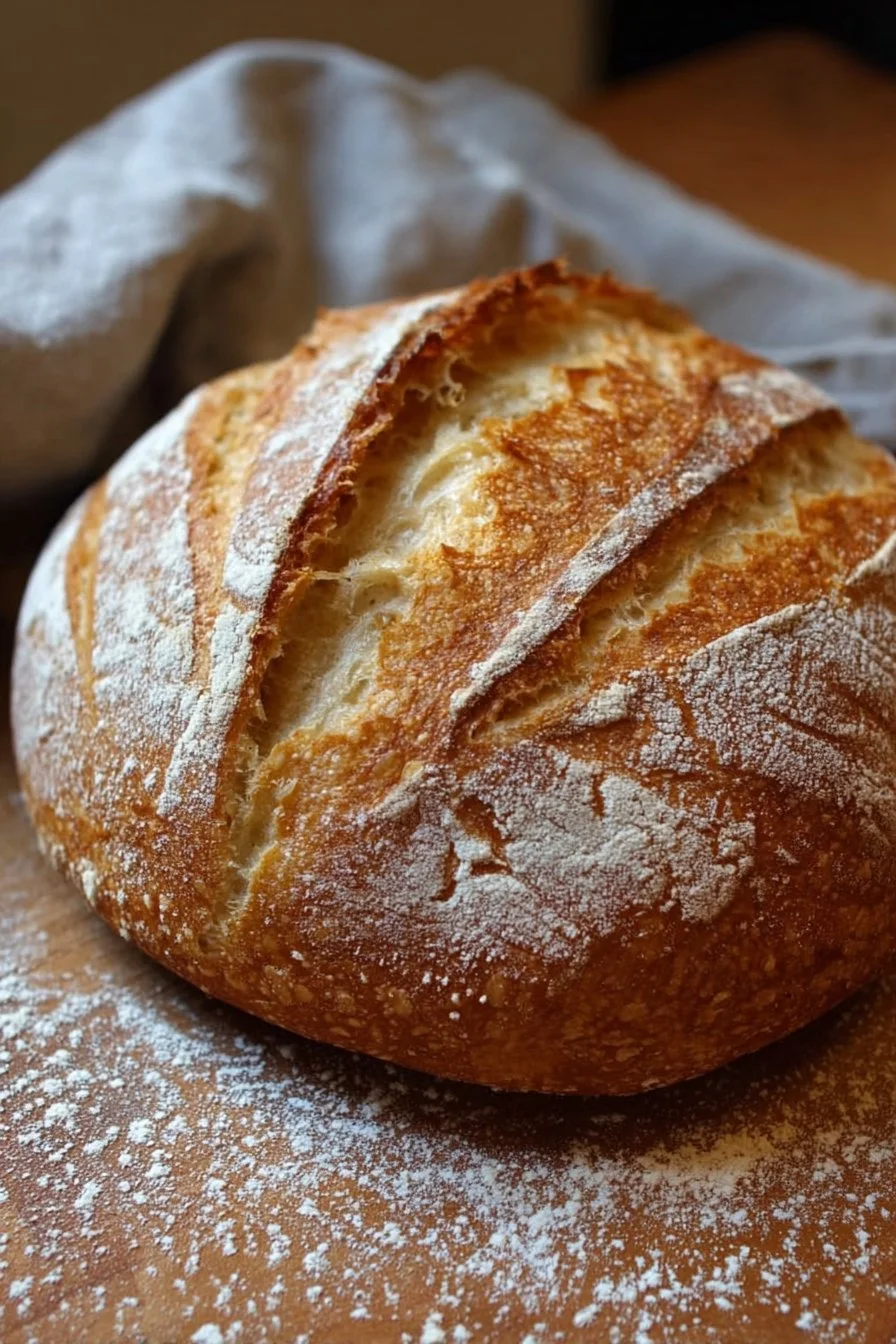
This high-starter sourdough pulls a lot of flavor and lift from a big portion of active culture, so you get tang, oven spring, and a quick-ish timeline without complicated timings or folds. It’s a forgiving, hands-on loaf that’s great for beginners who want a sourdough that tastes mature but doesn’t need an all-day schedule.
If you want a different no-fuss starter-forward loaf to compare techniques, check this no-fail sourdough guide for another approachable method.
Why you’ll love this dish
This recipe uses a high starter ratio (400 g starter) which gives you three big advantages: consistent fermentation, pronounced sourdough flavor, and faster bulk activity so you don’t have to babysit the dough all day. It’s ideal when your starter is booming and you want a reliably sour, open-crumb loaf without advanced timing.
“A straightforward, brave-tasting loaf—crispy crust, tender crumb, and beginner-friendly steps that still feel like real baking.” — home baker review
Perfect occasions: weekend baking, sandwiches for the week, brunch toast, or as a show-off loaf to bring to a potluck. Because it uses mostly pantry staples, it’s also budget-friendly and approachable for new bakers.
How this recipe comes together
This is a simple, mostly hands-off process broken into clear phases:
- Mix starter and water, then add flour + salt to form a wet, biscuit-like dough.
- Short bulk fermentation with a few sets of stretch-and-folds to build strength.
- Shape, cold-proof in the fridge (4–8 hours) to develop flavor and make the dough easier to score.
- Bake in a preheated Dutch oven at 400°F (204°C) — covered first for steam, then uncovered for crust color.
Expect about 3–4 hours active time across the day plus the chill in the fridge. The high starter makes bulk rise quicker, so watch the dough rather than the clock.
What you’ll need
- 2 cups active sourdough starter — about 400 grams (use a mature, bubbly starter; feed 4–8 hours before if needed).
- 3 cups sifted all-purpose flour — about 360 grams (sifted gives a lighter crumb; you can measure by weight for consistency).
- 1 cup warm water — about 240 grams (room-temp to slightly warm, ~75–85°F / 24–29°C).
- 1.5 teaspoons fine salt — ≈9 grams.
Notes and substitutions:
- If your starter is less than 100% hydration, adjust water slightly. This recipe assumes a 100% hydration starter (equal parts flour and water by weight).
- For more structure and nuttiness, replace up to 20–30% of the all-purpose flour with bread flour or whole wheat.
- For a richer flavor, fold in 1–2 tablespoons olive oil or 1 tablespoon honey (changes crust color and crumb slightly).
Step-by-step instructions
- In a large bowl, add 2 cups (400 g) active starter. It should be bubbly and aromatic.
- Whisk in 1 cup (240 g) warm water until evenly mixed and slightly loose.
- Add 3 cups (360 g) sifted all-purpose flour and 1.5 teaspoons (≈9 g) salt. Mix until the dough comes together into a wet, biscuit-like mass. It will be sticky but cohesive.
- Cover the bowl with a damp towel and let rest in a warm place (75–80°F / 24–27°C) for 2 hours. If your kitchen is cool, place the bowl in a warm oven (off) with the light on and rest for 1 hour instead.
- Perform the first set of stretch-and-folds: with wet hands, pick up one side of the dough and fold it over itself. Rotate the bowl and repeat until you’ve done 4–6 folds (about one set). This builds gluten gently.
- Cover and let rise 45 minutes. The dough should show some puffing and feel aerated.
- Repeat stretch-and-fold two more times (so you’ll do three sets total), allowing the dough to rise between sets. Each set strengthens the dough.
- After the fourth overall stretch-and-fold (i.e., final shaping set), shape the dough into a tight round loaf by cupping and rotating it on a lightly floured surface.
- Dust a towel or proofing basket (banneton) with flour, place the shaped dough seam-side up, and cover with a clean towel.
- Refrigerate (cold retard) for 4 to 8 hours. This firms the dough and develops flavor—longer in the fridge gives more tang.
- Preheat oven to 400°F (204°C) with a Dutch oven inside (lid on) for at least 30 minutes so it’s screaming hot.
- When ready to bake, lay a sheet of parchment on the counter and gently turn the chilled dough out onto it, seam-side down now.
- Score the top with a very sharp knife or razor to control expansion. Make quick, confident cuts.
- Using the parchment, carefully lift the dough into the hot Dutch oven and cover with the lid.
- Bake covered for 25 minutes — this traps steam and helps oven spring.
- Remove the lid and bake for another 25 minutes until the crust is deeply golden and crisp. If you prefer a darker crust, bake uncovered a few minutes longer, watching closely.
- Remove the loaf and cool on a rack for at least 1 hour before slicing to finish crumb set. Then slice and enjoy.
Chef note: total hydration is high (~78–79% assuming a 100% starter), so the dough will be slack. Don’t panic—stretch-and-folds and cold retard make this handleable.
Best ways to enjoy it
- Thick slices toasted with cultured butter and flaky sea salt.
- Turn into sandwiches — roast turkey with mustard and arugula or a creamy egg salad both shine.
- Use as the base for bruschetta or crostini topped with tomatoes and basil.
- Make grilled cheese with sharp cheddar and a smear of caramelized onions for luxury.
- For a savory brunch idea, pair warm slices with a soft-boiled egg and herby olive oil.
If you want an adventurous pairing idea, bring out bold, creamy bites inspired by recipes like chicken Alfredo monkey bread as a crowd-pleasing accompaniment.
Storage and reheating tips
- Room temperature: keep the loaf in a paper bag or wrapped in a clean tea towel for 1–2 days. This preserves crust texture.
- Refrigeration: not recommended for storing bread long-term — it speeds staling due to retrogradation. If you must, wrap tightly and use within 3–4 days.
- Freezing: slice and freeze in an airtight bag for up to 2–3 months. Reheat from frozen in a toaster or in the oven at 350°F (175°C) for 10–15 minutes. Whole loaves freeze well too; thaw at room temperature, then refresh in the oven for 8–10 minutes at 350°F.
- Reheating: to refresh a day-old loaf, spray or flick a little water on the crust and bake at 350°F for 8–12 minutes. For slices, a toaster or grill works great.
Pro chef tips
- Feed your starter so it’s peak-active 4–8 hours before you mix. Look for a bubbly, domed surface and a pleasant acidity.
- Temperature matters: warmer rooms shorten bulk time; cooler rooms lengthen it. Follow dough behavior rather than strict timings.
- Use a bench scraper and a floured surface for shaping if the dough is sticky. Keep your hands wet or lightly floured for the stretch-and-folds.
- For a crispier crust, remove the loaf from the Dutch oven for the last 5–10 minutes and bake directly on the rack. Watch closely to avoid burning.
- If the dough feels too loose when shaping, chill it for 15–30 minutes to firm up before final shaping.
- Want a more open crumb? Increase hydration slightly and reduce degassing when shaping. Want a tighter crumb? Use slightly less water and do a firmer shaping.
Creative twists
- Seeded loaf: press seeds (sesame, sunflower, flax) into the dough surface before the final rest or sprinkle on after scoring.
- Herb & garlic: fold in 1–2 tablespoons finely chopped fresh herbs and a minced clove of garlic at the second set of folds.
- Whole-grain: swap 20–30% of the all-purpose flour for whole wheat or spelt—expect a denser, more flavorful crumb. Add 5–10% extra water if using whole grains.
- Cheesy olive: press chopped olives and 3/4 cup grated sharp cheddar into the dough during one of the folds for a savory, pull-apart loaf.
Common questions
Q: My starter isn’t rising much—can I still use it?
A: Only use a starter that’s bubbly and roughly doubled after feeding. A sluggish starter will lead to poor rise and off flavors. If it’s not active, feed it for a few cycles at warm room temperature until it reliably peaks.
Q: How long should I cool the loaf before slicing?
A: At least 1 hour. The crumb continues to set as it cools; slicing too soon yields a gummy interior.
Q: Can I skip the fridge proof?
A: You can, but cold retard improves flavor and makes scoring easier. If short on time, let the shaped loaf proof at room temperature for 1–2 hours until slightly puffed, then bake — but expect a milder flavor.
Q: My crumb is dense—what went wrong?
A: Common causes: under-fermented dough, an inactive starter, insufficient folds to develop gluten, or cutting the rise short. Make sure the dough shows clear aeration before shaping and practice the stretch-and-fold rhythm.
Q: Is this recipe gluten-free friendly?
A: No. This recipe relies on wheat gluten to develop structure. For gluten-free sourdough, use a dedicated gluten-free starter and flour blends formulated for that purpose.
Q: Can I make the dough ahead and freeze it before baking?
A: Yes. After shaping, wrap the loaf tightly and freeze. Thaw overnight in the fridge, then bring to room temp and bake. You may need an extra 5–10 minutes in the oven.
Enjoy the process—the high-starter method rewards you with bold flavor and a quick path to a bakery-worthy loaf. Happy baking!
Print
High-Starter Sourdough Bread
- Total Time: 230 minutes
- Yield: 1 loaf
- Diet: Vegetarian
Description
A beginner-friendly sourdough loaf with a crispy crust and tender crumb, featuring a high starter ratio for pronounced flavor and faster rise.
Ingredients
- 2 cups active sourdough starter (about 400 g)
- 3 cups sifted all-purpose flour (about 360 g)
- 1 cup warm water (about 240 g)
- 1.5 teaspoons fine salt (≈9 g)
Instructions
- Add 2 cups (400 g) active starter to a large bowl.
- Whisk in 1 cup (240 g) warm water until evenly mixed.
- Add 3 cups (360 g) sifted all-purpose flour and 1.5 teaspoons (≈9 g) salt. Mix until the dough forms a wet, sticky mass.
- Cover the bowl with a damp towel and let rest in a warm place for 2 hours.
- Perform the first set of stretch-and-folds for strength, then let rise for 45 minutes.
- Repeat the stretch-and-fold two more times, allowing dough to rise in between.
- Shape the dough into a tight round loaf and place seam-side up in a floured basket.
- Refrigerate for 4 to 8 hours to develop flavor.
- Preheat oven to 400°F (204°C) with a Dutch oven inside.
- Turn the chilled dough onto parchment and score the top.
- Lift the dough into the hot Dutch oven and cover.
- Bake covered for 25 minutes, then uncover and bake another 25 minutes until golden.
- Cool on a rack for 1 hour before slicing.
Notes
If your starter is less than 100% hydration, adjust water slightly. For a richer flavor, consider adding olive oil or honey.
- Prep Time: 180 minutes
- Cook Time: 50 minutes
- Category: Bread
- Method: Baking
- Cuisine: American