
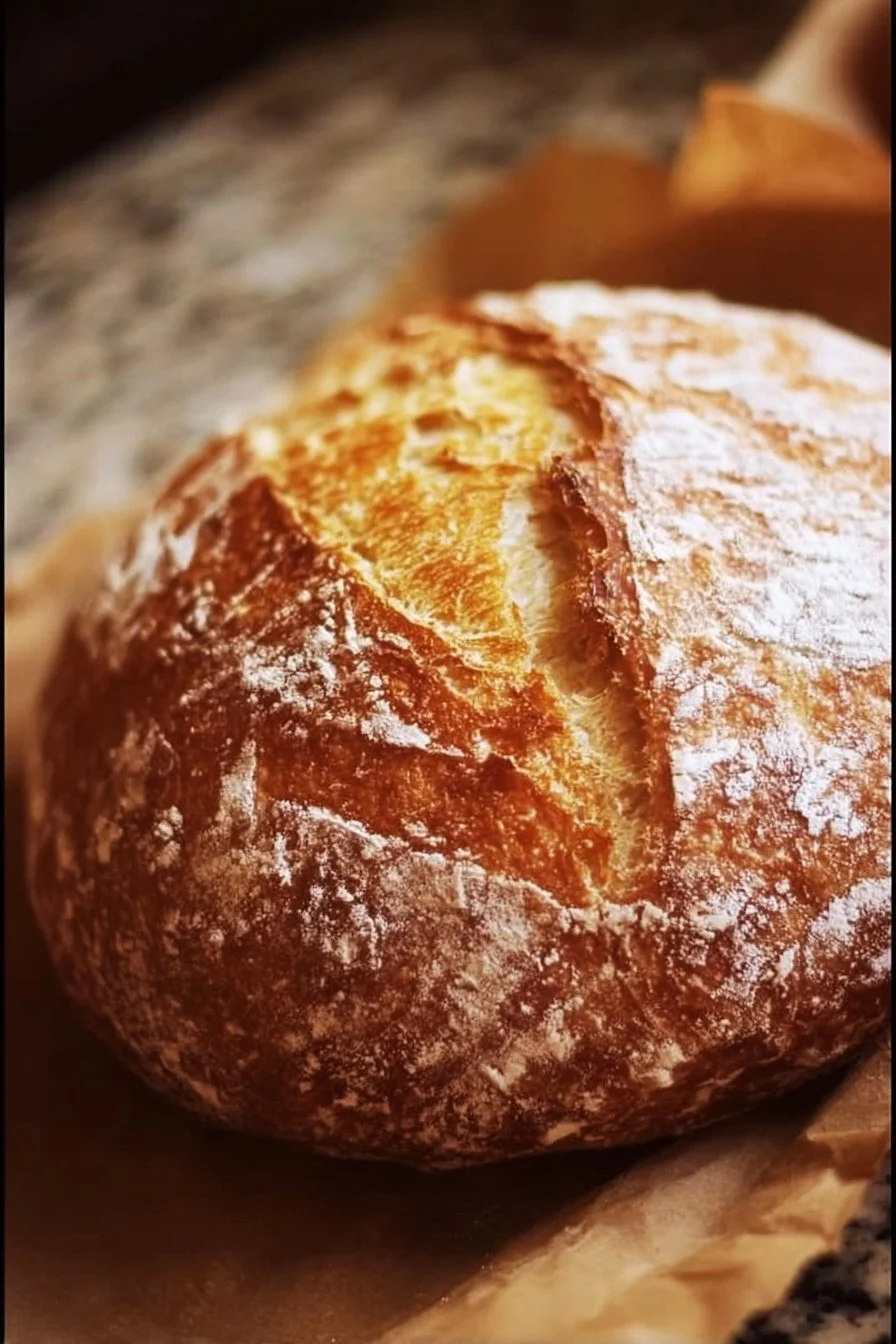
This no-knead, one-bowl artisan loaf gives you a crisp, deeply colored crust and an airy, open crumb with almost no hands-on time. It’s the kind of bread home cooks make when they want bakery-quality results without fuss — perfect for weekend brunch, soup night, or slicing for sandwiches. If you enjoy a garlicky, herby twist on this method, try the garlic herb Dutch oven bread for an easy flavored variation.
Why you’ll love this loaf
This recipe is deceptively simple: three cups of flour, a pinch of yeast, a generous rest, and a hot Dutch oven are all it takes. It’s ideal for people who want great bread but don’t have hours of active work or advanced kneading skills. Benefits at a glance:
- Minimal hands-on time — mix, wait, shape, bake.
- No special equipment beyond a heavy pot with lid (4–6 qt Dutch oven recommended).
- Consistent, reliable crust and crumb with a single overnight rise.
- Budget-friendly: pantry staples create a bakery-style loaf.
“The crust was impossibly crisp and the inside soft and airy — exactly what I hoped for from a no-knead method.” — happy home baker
This bread works for weeknight dinners, holiday sides, picnic sandwiches, or as a show-off loaf for guests.
How this recipe comes together
A quick overview so you know what to expect:
- Combine flour, salt, and instant yeast until even.
- Add room-temperature water and stir to a shaggy, sticky dough.
- Cover and let the dough ferment at room temperature for 12–18 hours — this long, slow rest builds flavor and gas for an open crumb.
- Preheat a heavy Dutch oven to 450°F (230°C) so the vessel is piping hot when the dough goes in.
- Shape the risen dough gently, place it on parchment, and bake covered for 30 minutes. Removing the lid finishes the crust for another 15 minutes.
- Cool at least 45 minutes before slicing so the interior sets properly.
Expect about 10 minutes active prep time and 12–18 hours of passive fermentation, plus 45–60 minutes of cooling and baking time.
What you’ll need
- 3 cups (360 g) all-purpose flour — you can substitute part (up to 50%) with bread flour for more chew.
- 1 1/2 teaspoons fine salt
- 1/2 teaspoon instant yeast (also called rapid-rise or fast-acting)
- 1 1/2 cups (360 ml) water, room temperature
Notes:
- Weighing the flour (360 g) is more accurate than measuring by volume. If your flour is scooped, the loaf may be dense.
- Instant yeast is used because it mixes directly into dry ingredients. If using active dry yeast, proof it in a little warm water first (see FAQs).
- For whole-wheat or gluten-free swaps, see the Variations section.
Step-by-step instructions
- Whisk dry ingredients: In a large bowl, whisk together the flour, salt, and instant yeast until evenly distributed. This ensures even seasoning and yeast distribution.
- Add water and stir: Pour in the 1 1/2 cups water. Stir with a wooden spoon or spatula until the dough forms a wet, sticky, shaggy mass. Scrape the sides — a bit of flour should remain on the bowl.
- Cover and ferment: Cover the bowl tightly with plastic wrap or a lid. Let sit at room temperature for 12–18 hours. The dough should double and show bubbles on the surface and edges.
- Preheat Dutch oven: About 30 minutes before baking, place a 4–6 quart Dutch oven (lid on) into the oven and preheat to 450°F (230°C). Preheating the pot creates instant steam and strong oven spring.
- Shape gently: Lightly flour a clean surface. Turn the dough out and fold the edges into the center once or twice to form a loose round. Don’t overwork it — you want to preserve the gas bubbles.
- Transfer to parchment: Place the dough seam-side down on a piece of parchment large enough to lift the loaf. Use the parchment to transfer the dough safely into the hot pot.
- Bake covered: Put the dough (on parchment) into the preheated Dutch oven, cover, and bake for 30 minutes. The lid traps steam for a crisp, blistered crust.
- Finish uncovered: Remove the lid and bake for another 15 minutes until the crust is deep golden brown and sounds hollow when tapped.
- Cool fully: Remove the loaf and cool on a wire rack for at least 45 minutes before slicing — slicing too soon produces a gummy crumb.
Timing tip: If your kitchen is cool, aim for the longer end of the fermentation window (18 hours); if warm, check earlier.
Best ways to enjoy it
This bread is outrageously versatile. Serve it warm with salted butter for breakfast, use thick slices for grilled cheese, or tear it into chunks for a hearty stew. For a garlic-and-cheese pairing that complements the crust, consider trying my garlic parmesan herb bread — it uses the same no-knead method with extra flavor additions.
Pairing ideas:
- Olive oil and flaky salt for dipping
- Simple bruschetta with tomatoes, basil, and balsamic
- Thick slices under a layer of melted gruyère and caramelized onions
- Serve alongside soups (tomato, minestrone) or stews (beef bourguignon)
Storage and reheating tips
- At room temperature: Store the cooled loaf wrapped in a clean kitchen towel or in a paper bag for 2–3 days. Plastic will soften the crust.
- Freezing: Slice and freeze in airtight bags for up to 3 months. Toast slices straight from the freezer or reheat in a 350°F (175°C) oven for 10–15 minutes.
- Reheating: To revive crust, sprinkle a little water over the loaf, wrap loosely in foil, and bake at 350°F (175°C) for 10–12 minutes. For individual slices, toast until crisp.
- Safety: Bread is not a high-risk food for bacterial growth, but always discard if you see mold. Freeze instead of refrigerating — refrigeration dries bread out faster.
Pro chef tips
- Weight your flour: Use 360 g for consistent results. Measuring by volume varies too much between scooping and spooning.
- Hydration feel: The dough should be sticky and shaggy. Don’t add extra flour while mixing — you can dust your hands lightly when shaping.
- Handle gently: Minimal folding preserves the bubbles formed during fermentation, leading to a lighter crumb.
- Hot pot trick: Always preheat the Dutch oven. A cold pot kills oven spring and gives a denser loaf.
- Paring knife or lame: If you like a decorative slash, score the dough just before placing it in the pot — this controls where the loaf expands.
- Alt proof: If your kitchen is warm, reduce fermentation time. For more flavor, you can retard fermentation in the fridge for 24–48 hours (see Variations).
Creative twists
- Seeded top: Brush the shaped dough lightly with water and press sesame, poppy, or sunflower seeds onto the surface before baking.
- Whole-grain version: Replace up to 1 1/2 cups (180 g) of AP flour with whole-wheat; add 15–30 minutes extra fermentation and a touch more water.
- Cheese and herbs: Fold grated parmesan and chopped rosemary into the dough after the initial mix for a savory loaf.
- Olives & sundried tomatoes: Gently fold in chopped olives and sundried tomatoes after the bulk rise for a Mediterranean loaf.
- Cold fermentation: Mix in the evening, refrigerate covered 12–48 hours, then shape and bake. Cold proof enhances flavor and control over timing.
Common questions
Q: Do I need a Dutch oven?
A: You don’t strictly need one, but a heavy lidded pot traps steam and replicates a professional steam oven, producing the best crust. Alternatives: a heavy roasting pan with a tray of hot water below, or bake the loaf on a preheated baking stone and spritz the oven with water several times during the first 10 minutes.
Q: Can I use active dry yeast instead of instant?
A: Yes. If using active dry yeast, dissolve it in about 2 tablespoons of the recipe water (warmed to ~100–110°F/38–43°C) and let it bubble for 5–10 minutes before mixing with the other ingredients. Then proceed with the recipe.
Q: Why must I wait 45 minutes before slicing?
A: The crumb continues to set as the loaf cools. Cutting too early releases steam and can make the interior gummy rather than fully set and airy.
Q: How long will this bread stay fresh?
A: At room temperature, 2–3 days in a paper bag or wrapped in a towel. For longer storage, slice and freeze for up to 3 months.
Q: My dough was sticky and hard to shape — what went wrong?
A: That texture is normal for this high-hydration, no-knead method. Lightly flour your hands and work surface, fold gently, and avoid adding large amounts of extra flour — it can make the loaf dense.
If you want more oven-baked bread inspiration, try one of the flavored versions linked earlier for variations that keep the same easy technique but add herbs, garlic, or cheese.
Print
No-Knead Artisan Loaf
- Total Time: 12-18 hours (plus cooling time)
- Yield: 1 loaf
- Diet: Vegetarian
Description
A simple no-knead, one-bowl artisan loaf with a crisp crust and airy crumb, perfect for sandwiches or as a side for soups.
Ingredients
- 3 cups (360 g) all-purpose flour
- 1 1/2 teaspoons fine salt
- 1/2 teaspoon instant yeast
- 1 1/2 cups (360 ml) water, room temperature
Instructions
- In a large bowl, whisk together the flour, salt, and instant yeast until evenly distributed.
- Add the water, and stir until a wet, sticky, shaggy dough forms.
- Cover tightly and let sit at room temperature for 12–18 hours.
- About 30 minutes before baking, preheat a 4–6 quart Dutch oven to 450°F (230°C).
- Lightly flour a surface, turn out the dough, and fold it into a loose round.
- Transfer the dough to a piece of parchment paper, seam-side down.
- Carefully place the dough in the hot Dutch oven, cover, and bake for 30 minutes.
- Remove the lid and bake for an additional 15 minutes until golden brown.
- Cool on a wire rack for at least 45 minutes before slicing.
Notes
Weighing the flour ensures better results. Store wrapped in a kitchen towel at room temperature for 2-3 days or freeze for longer storage.
- Prep Time: 10 minutes
- Cook Time: 45 minutes
- Category: Bread
- Method: Baking
- Cuisine: American