
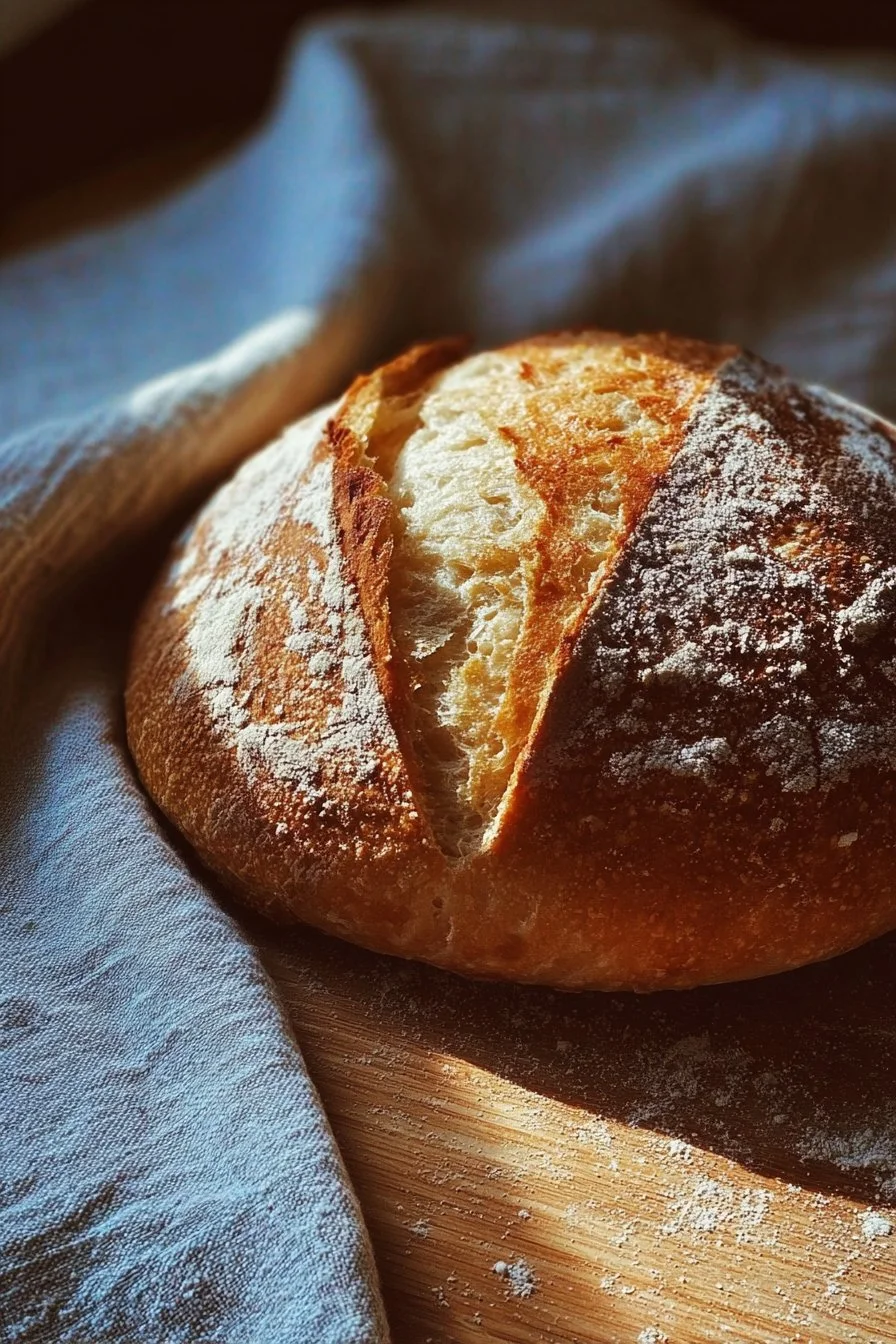
I still remember the first time I pulled a steaming boule of sourdough from a hot Dutch oven — the crust crackled, the crumb was chewy, and the tang was just right. This recipe is a straightforward, reliable way to make that loaf at home using 4 cups (500 g) flour, 1⅔ cups (375 g) warm water, 1 cup (200 g) active starter and 2 teaspoons (10 g) salt. If you like a dependable technique with minimal fuss and lots of hands-off time, compare techniques with Nina’s no-fail sourdough bread method to see how different pro tips can change outcomes.
Why you’ll love this loaf
This sourdough formula hits a sweet spot: simple ingredients, clear timing, and a weekend-friendly rhythm. It’s a great entry point for home bakers who want real sourdough flavor without an intimidating multi-day process. You mix, do a few stretch-and-folds, proof a long cold night, then bake in a hot Dutch oven for that coveted oven spring and crisp crust.
“A forgiving recipe that delivers a crunchy crust and soft, slightly tangy crumb — perfect for sandwiches or toast.” — a practical home-baker review
This is ideal for weekend breakfasts, casual dinner sides, or when you want bread that improves with minimal effort.
Step-by-step overview
Before you start, here’s the big picture so you know what to expect:
- Mix flour and warm water to form a shaggy dough and rest (autolyse).
- Add active starter and salt, then do stretch-and-folds over 2 hours.
- Bulk ferment until doubled (about 6–8 hours at room temp).
- Shape, place seam-side up in a proofing basket, then cold retard in the fridge 8–12 hours.
- Bake in a preheated Dutch oven at 450°F (232°C): covered 20 minutes, uncovered 25 minutes.
This rhythm means most of the active work happens early, and the long fermentation builds flavor and texture.
What you’ll need
- 4 cups (500 g) bread flour or all-purpose flour
- 1⅔ cups (375 g) warm water (about 75–80°F / 24–27°C)
- 1 cup (200 g) active sourdough starter (fed and bubbly)
- 2 teaspoons (10 g) fine salt
Notes and substitutions:
- Bread flour gives a chewier crumb thanks to higher protein; AP flour still makes excellent loaves.
- If your starter is sluggish, feed it 4–8 hours before using so it’s active and bubbly.
- For whole-wheat swaps, replace up to 20–30% of the flour with whole-wheat flour and expect a slightly denser crumb.
Step-by-step instructions
- In a large mixing bowl, combine the flour with the warm water. Stir until a shaggy, hydrated dough forms. Cover and rest for 30 minutes (autolyse).
- Add the active sourdough starter and the salt. Mix thoroughly until everything is incorporated — the dough will be sticky but cohesive.
- Cover the bowl. Over the next 2 hours perform a series of stretch-and-folds every 30 minutes (lift one side of the dough, stretch it up, fold it over; turn the bowl and repeat 4–6 times each session).
- After the final fold, cover and leave the dough at room temperature to bulk ferment. This should take about 6–8 hours, or until the dough roughly doubles in size.
- Gently turn the dough out onto a lightly floured surface. Shape it into a round (boule) or oval (batard) by folding the edges under to create tension on the surface.
- Place the shaped dough seam-side up in a floured proofing basket (banneton). Cover and refrigerate for 8–12 hours to slowly proof and develop flavor.
- Preheat your oven to 450°F (232°C) with a Dutch oven inside for at least 30 minutes so it’s thoroughly hot.
- Remove the dough from the fridge, invert it onto parchment, and score the top with a sharp lame or knife to control expansion.
- Carefully lower the dough (on the parchment) into the hot Dutch oven. Cover and bake for 20 minutes.
- After 20 minutes, remove the lid and bake another 25 minutes until the crust is deep golden brown.
- Transfer the loaf to a wire rack and cool completely before slicing — at least 1–2 hours. Cooling finishes the internal crumb structure and keeps the crumb from being gummy.
How to serve Sourdough Bread
- Slice and serve warm with softened butter for breakfast. The crisp crust and chewy interior are ideal for simple toppings.
- Make hearty sandwiches: roast meats, sharp cheeses, and pickles stand up well to sourdough’s tang.
- Turn thick slices into toasted crostini for soups and salads, or use cubes for savory bread pudding and strata.
- For brunch, pair with creamy avocado and a drizzle of olive oil, or use as the base for egg-in-a-hole.
Storage and reheating tips
- Room temperature: Keep the loaf in a paper bag or bread box for 2–3 days to preserve crust texture. Plastic will keep it softer but increases condensation and mold risk.
- Freezing: Slice the loaf and freeze slices in an airtight bag for up to 3 months. Toast or thaw slices straight from the freezer.
- Reheating: Refresh slices in a toaster or re-crisp a whole loaf in a 350°F (175°C) oven for 8–10 minutes; for a softer crust, wrap in foil for the last few minutes.
- Food safety: If you see mold, discard the entire loaf. Don’t attempt to cut mold away from bread.
Pro chef tips
- Temperature matters: Aim for a dough temperature of about 75°F (24°C) after mixing to keep fermentation predictable.
- Hydration handling: This recipe is moderately wet. Use wet hands when shaping to reduce sticking and maintain surface tension.
- Stretch-and-fold rhythm: The point is to build structure without heavy kneading. If your dough doesn’t hold shape after the first two sessions, continue folds until it shows some elasticity.
- Scoring angle: Score at a shallow angle (20–30°) for controlled ear formation. A quick confident cut produces a better oven spring than hesitant snips.
- Steam and crust: The covered Dutch oven traps steam; remove the lid halfway through to caramelize the crust.
Recipe variations
- Garlic-herb boule: Mix finely minced garlic and chopped rosemary into the dough at the final mixing stage for a savory loaf.
- Olive and thyme: Fold in chopped oil-cured olives and fresh thyme after the initial folds for a Mediterranean twist.
- Seeded crunch: Roll the shaped loaf in a mix of seeds (sesame, flax, sunflower) before proofing for an attractive, crunchy exterior.
- Enriched cheddar loaf: Add shredded sharp cheddar into the dough for a cheesy pull-apart texture.
- Fun sweet version: Gently fold in cinnamon-sugar and raisins during shaping for a dessert-style loaf.
For a playful savory twist that transforms bread into a party pull-apart, see inspiration like the Chicken Alfredo monkey bread idea and adapt the same pull-apart technique with sourdough dough and savory fillings.
Common questions
Q: How long does the whole process take from start to finish?
A: Active hands-on time is under an hour (mixing, folds, shaping). The clock includes a 30-minute autolyse, 2 hours of intermittent folding, 6–8 hours bulk ferment, 8–12 hour cold retard, and 45 minutes of baking. Plan roughly 18–24 hours total with passive time.
Q: My crumb is gummy — what went wrong?
A: Gummy crumb usually means the loaf didn’t bake long enough, or it was sliced before cooling. Make sure the internal temperature reaches about 205–210°F (96–99°C) and cool the loaf fully on a rack.
Q: Can I speed up the process to make it in one day?
A: Yes — raise room temperature to speed fermentation and shorten the cold retard, but flavor depth and crust complexity benefit from the slow overnight chill. For a same-day loaf, expect a milder flavor and plan for tighter, warmer bulk fermentation.
Q: What if my starter isn’t very active?
A: Feed your starter 4–8 hours before making dough so it’s bubbly and at peak activity. If you must use a less-active starter, give the bulk fermentation more time and watch for a visual doubling rather than strict clock time.
Q: Can I use a stand mixer?
A: You can, but this recipe relies on stretch-and-folds to develop gluten gently. If using a mixer, knead on low for 4–6 minutes until the dough is elastic and then proceed with the bulk rise.
Q: Is it necessary to refrigerate overnight?
A: The cold retard isn’t strictly necessary, but it improves flavor, makes shaping easier, and fits a convenient schedule. Shorten or skip the fridge for quicker results.
If you have other questions about timings, starter troubleshooting, or texture goals, ask and I’ll help you tweak the method for your kitchen conditions.
Print
Sourdough Bread
- Total Time: 720 minutes
- Yield: 1 loaf
- Diet: Vegetarian
Description
A straightforward sourdough recipe for a crunchy crust and soft, tangy crumb, perfect for sandwiches or toast.
Ingredients
- 4 cups (500 g) bread flour or all-purpose flour
- 1⅔ cups (375 g) warm water (about 75–80°F / 24–27°C)
- 1 cup (200 g) active sourdough starter (fed and bubbly)
- 2 teaspoons (10 g) fine salt
Instructions
- Combine the flour and warm water in a large mixing bowl until a shaggy dough forms. Cover and rest for 30 minutes (autolyse).
- Add the active sourdough starter and the salt, mixing thoroughly until incorporated.
- Cover the bowl and perform a series of stretch-and-folds every 30 minutes for 2 hours.
- Leave the dough at room temperature to bulk ferment for about 6–8 hours, until it doubles in size.
- Shape the dough into a round (boule) or oval (batard) by folding the edges under to create tension.
- Place the shaped dough seam-side up in a floured proofing basket, cover, and refrigerate for 8–12 hours.
- Preheat your oven to 450°F (232°C) with a Dutch oven inside for at least 30 minutes.
- Invert the dough onto parchment, score the top, and carefully lower into the hot Dutch oven.
- Cover and bake for 20 minutes, then remove the lid and bake for another 25 minutes until golden brown.
- Transfer the loaf to a wire rack and cool completely before slicing for at least 1–2 hours.
Notes
Store at room temperature in a paper bag for 2–3 days or freeze slices for up to 3 months. Refresh in a toaster or oven for best results.
- Prep Time: 60 minutes
- Cook Time: 45 minutes
- Category: Bread
- Method: Baking
- Cuisine: American